All About Filament Drying 🔥
* Long post, but it will save you money, prints, and a lot of frustration. **
Storing filament properly is one of the easiest ways to improve print quality, reduce failures, and extend the lifespan of your materials. This guide covers:
- Types of filaments
- How humidity affects them
- The best storage methods
- What actually works in Indian weather
- Community-tested tips (compiled from WhatsApp group discussions)
🌡️If you’re in India, assume your filament always needs airtight storage, even PLA. Humidity here is no joke — please don’t believe anyone who says, “I just leave my spool out, works fine.” It doesn’t.
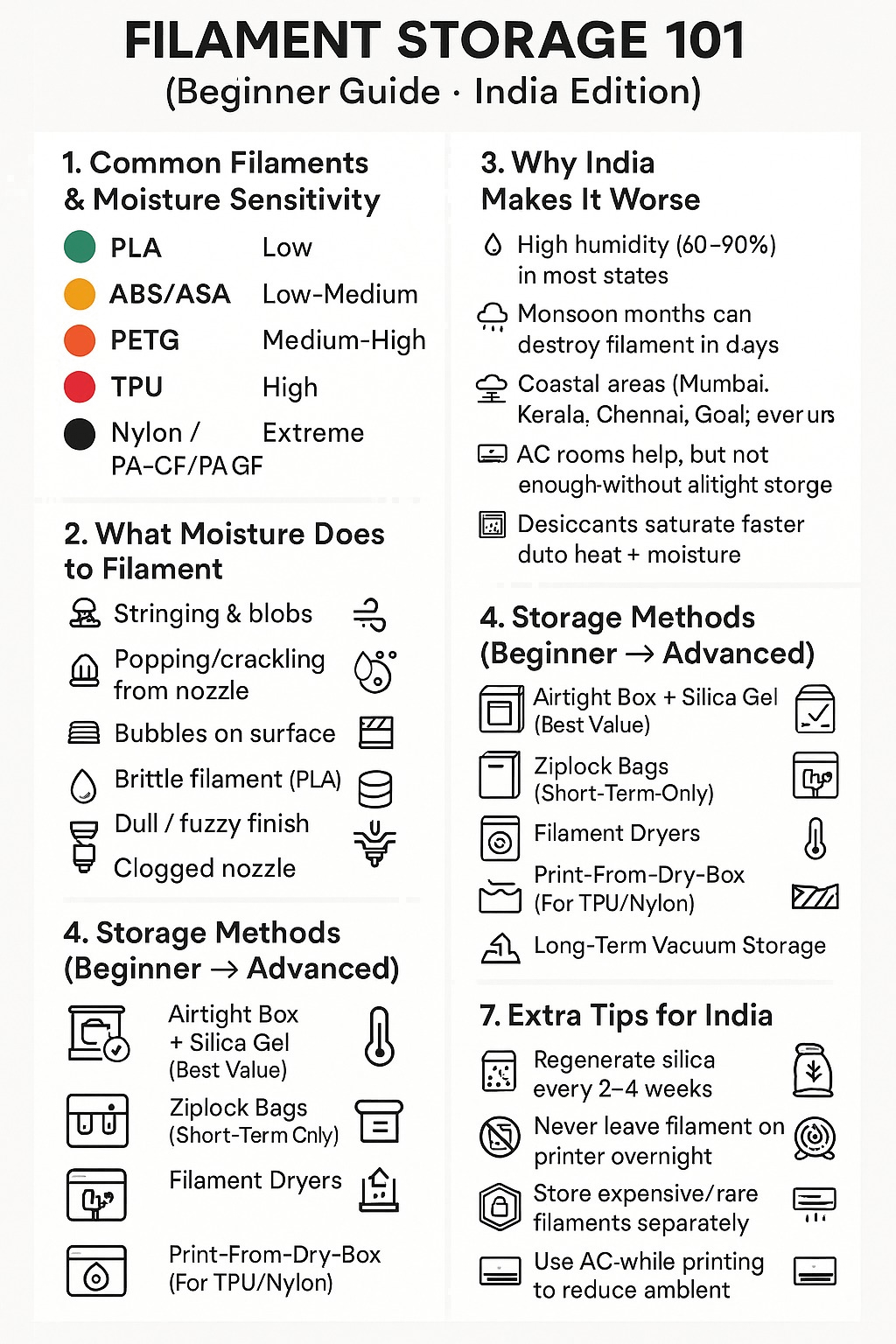
| Filament Type | Hygroscopic Level | Storage |
|---|---|---|
| PLA | Low | Sealed Box + Desiccant |
| PETG | High | Vacuum Bag + Desiccant |
| ABS / ASA | Medium | Airtight Box + Desiccant |
| TPU | Very High | Print directly from heated drybox |
| Engineering Filaments* | Very High | Print directly from heated drybox |
Filament Type Hygroscopic Level Storage PLA Low Sealed Box + Desiccant PETG High Vacuum Bag + Desiccant ABS/ASA Medium Airtight Box + Desiccant TPU Very High Print directly from heated drybox. Engineering Filaments* Very High Print directly from heated drybox. * Engineering Filaments like Nylon, PA-CF, PA-GF.
💧 Signs Your Filament Is Wet
Beginners often confuse moisture issues with printer problems. Here’s what “wet filament” looks like:
✔️ Pops and crackles during extrusion ✔️ Stringy prints ✔️ Under-extrusion ✔️ Layer adhesion problems ✔️ Matte, fuzzy surface ✔️ Bubbles or pitting on walls ✔️ Brittle filament (PLA especially)
I will try to cover all the options which people have shared over time for storage of filaments.
🟠 Desiccant: The Must-Have
A must have if you store multiple spools like me. Buy this color-indicating silica gel beads - Orange Color Indicating. These beads come in dull orange color and turn dull green when saturated. They can be dried in Oven/Microwave/Air Fryer and could be reused multiple times. You would also see blue color-indicating silica gel beads, try to avoid those as they contain toxic Cobalt and they are even banned in EU. Orange ones are less toxic and are widely used.
Best and Safest is to use the white silica non-indicating gel beads - White Non-Indicating. For color indicating feature, you could add a small amount of orange color indicating gel beads. This idea came from Bambu Labs Spool packaging, they use the same white mixed with some orange.
📦Desiccant holders
Now you have desiccant, print some of these - Spool Desiccant Holders and fill these up in desiccant beads and shove it between spools before storing them. I even use them in Bambu Labs AMS. Similarly based on your printer, try to look for other kind of desiccant holders.
Now let's talk about Filament Storage Solutions -
🛍️Zip lock Bags -
Yes, the normal zip lock bags like these could work for PLA reliably. Look for 30cm x 35cm size of bags which reliable fit one spool. People have used vacuum cleaners to seal the bags even - Vacuum seal normal Zip Lock bags.
🌀Vacuum Storage Bags -
An upgrade to zip lock bags is the vacuum sealed bags. These bags work as zip lock bags only, but they have an air valve from which air can be vacuumed out with a manual or electronic pump. These are also called sous vide bags if you are looking to hunt these in China or local market for cheap. Look for size - 30cm x 34 cm. Some of good options are - Serplex 10 bags with pump or 2Heet 6 bags. (~₹60-₹80 per bag)
💡 Now if you are looking for "Desi Jugaad", you can get those vacuum seal bags for clothes, they are a lot bigger like (60cm x 40cm for even the small one), but they do the job, that's vacuum storing the filaments. Some good options are - 5 bags with Electric Pump, 5 bags with manual pump. (~₹80-100 per bag). Meesho/Deodap has some cheaper offerings - (2 Small,2 Medium,1 Large), Vacuum Storage Bags with Suction Pump, Portable USB Rechargeable Vacuum Sealer Machine. These are significantly budget options.
Spool Drybox -
Now an upgrade from bags and pumps is to get an airtight sealed box. A good option is to have this Container, this stores a single spool perfectly and it's air-tight.
A universal and globally used option is to have Ikea Samla 22L and Samla 45L boxes. One good thing about Samla is that there are multiple mods available on MakerWorld and Printables.com like desiccant boxes, clips etc. To make Samla airtight use a gasket like this . Samla 22L and 45L can approximately hold 4 and 8 filaments respectively.
Another option is to use Aristo 403 as well. Already airtight and comes with clips. Apart from Amazon, try to search from local market. People have sourced these for ~₹300 a piece locally.
Also, your local D-Mart or Reliance Fresh might have similar boxes called Joyful, Joyo, Nakoda etc. Storage and Organizers. Courtesy to ~Berlin on Whatsapp, he designed a clip for Joyo Super Box
⚠️ Standard spool size is ~20 × 20 × 6 cm — measure before buying.
You can also get Pneumatic Connectors Link 1 | Pneumatic Connectors Link 2 and PTFE Tubes to print directly out of your drybox. Remember to check dimensions for compatibility with your 3d printers. Bambu recommends ID-2.5mm OD-4mm.
🔥This was about the storage of filaments and keep them dry, but if your filaments are already wet, then you have to dry them actively.
Microwave/Oven/Air Fryer/Toaster
While you will find many people on YouTube saying they dry their filaments this way, I would not recommend it. Having these plastics hot anywhere where the food is cooked is not a good idea. If you have a spare appliance, then try it but be very careful about it.
Your Printer
There is a heater already in-built your 3d printer, the heat-bed. Some examples - Example, Example, Example.
Filament Dryers -
You can find some good filament dryers available on various sites. Also in WhatsApp group, try to contact ~Ankit and see if he has some available. One of the biggest advantages is that some models let you dry the filaments while also printing from them. This is actually needed for TPU, Nylon and even PETG I would say.
🔧DIY Realm -
You can buy a cheap PTC heater and put it in the boxes mentioned above and you have a Filament Drybox for yourself. Add some fans, throw in some ESP32 and you have a way better drybox which you make given that you have the time and know-how to build one. Well, this is a topic for some other time to go in detail but there are numerous examples of the same - Example, Example, Example
Also, there are options to use Food Dehydrator and turn that into Filament dryer. You can buy a food dehydrator like this and then turn it into filament dryer like this - Example, Example, Example, Example
💡Note on Drying Time and Temperatures
| Material | Temperature | Time | Notes |
|---|---|---|---|
| PLA | 45–50°C | 4–6 hrs | Softens >55°C |
| PETG | 60–65°C | 6–8 hrs | Very hygroscopic |
| ABS / ASA | 65–70°C | 4–6 hrs | Improves adhesion |
| TPU | 45–55°C | 6–8 hrs | Warps easily in heat |
| Nylon / PA-CF | 70–80°C | 8–12 hrs | Needs long drying |
📉Hygrometers -
There is a famous saying - "You can only improve something which you can measure". So, you would need hygrometers to measure Relative humidity. Buy them in bulk so you know that the system you are using is working for you. I would say buy one of the HTC 1 and HTC 2 to calibrate and then buy the cheap FY 11 or FY12 hygrometers in bulk and shove them everywhere like in your AMS, in your dryboxes etc. You can get FY11/12 hygrometers for a little cheaper (like ₹20-30 less) on sites like Robu, Makerbazaar or Robocraze etc.
Note - If you are someone like me who loves to tinker, only then look for DIY options or the so-called Jugaad options. For the majority just buy the commercial offerings and that would serve them well.
PS - This is not just me, over time many people have shared their experiences. I have just compiled this overtime.
And here is everything in an infographic -